

Yes, you can use certain essential oils cautiously during pregnancy, but the rule that matters most is simple: never ingest them, and strongly favor inhalation or properly diluted topical use over anything stronger. Use extra caution in your first trimester or with certain medical conditions, and talk with your prenatal care provider before starting any routine. If you ever suspect a bad reaction, Poison Control and your clinician are your first calls.
Key Takeaways
Use inhaled or diluted topical essential oils during pregnancy with caution and only under medical guidance, avoiding ingestion and high-concentration use to minimize risks.
|
Point |
Details |
|
Use inhalation and dilution |
Favor inhalation or proper dilution of essential oils over ingestion or concentrated topical application during pregnancy. |
|
Avoid risky oils |
Steer clear of clary sage, pennyroyal, wintergreen, camphor, and large doses of rosemary, thyme, and oregano. |
|
Test before use |
Patch test new oils on small skin areas and wait 24 hours to check for reactions. |
|
Be especially cautious in the first trimester |
Many clinicians recommend skipping nonessential aromatherapy during early pregnancy due to organ development vulnerability. |
|
Palinova recommends low-dose inhalation |
We advise low-concentration inhalation and consulting healthcare providers to ensure safe use during pregnancy. |
Table of Contents
-
2. Essential oils to avoid: clear list with reasons and risk signals
-
6. Evidence summary: trials, clinical guidance, and practical takeaways
-
7. Potential benefits and risks of essential oils on fetal development
-
8. Interactions of essential oils with common pregnancy medications or conditions
-
10. How we think about safety when customers ask us about pregnancy
1. Pregnancy-safe essential oils and what each may help
Several oils show up again and again in aromatherapy guidance for pregnancy, mostly because they carry a reasonable safety record when inhaled or diluted rather than applied heavily or swallowed.
-
Lavender: commonly used for sleep and anxiety, inhaled via diffuser or a drop on a pillow.
-
Lemon: targeted at nausea, and the one oil with real trial support behind it.
-
Roman chamomile: used for general relaxation and tension.
-
Frankincense: used for calming and mild aches, typically diluted for topical use.
-
Ginger: another nausea-focused oil, usually inhaled rather than applied to skin.
-
Rose: used for anxiety and sleep support, almost always diluted heavily given its potency.
A randomized, double-blind trial found lemon aromatherapy reduced nausea scores compared with placebo, with no adverse effects reported, according to Evidence Based Birth’s review of pregnancy aromatherapy trials. That same review notes peppermint trials were mixed: two separate studies found no significant benefit over placebo, so treat peppermint as a weaker bet for nausea despite its popularity.
A few caveats apply by condition. Peppermint’s menthol content warrants caution if you have a seizure disorder, and some clinicians flag it for people with G6PD deficiency. When in doubt about a specific oil and your own health history, ask your provider before adding it to your routine.
2. Essential oils to avoid: clear list with reasons and risk signals
Some oils carry risks specific enough that most clinical guidance puts them off-limits in pregnancy, regardless of how they’re marketed.
-
Clary sage: linked to uterine-stimulating effects, generally avoided until labor itself.
-
Pennyroyal: associated with documented hepatic toxicity, even at modest exposure.
-
Wintergreen: contains methyl salicylate, which carries toxicity risk at concentrations found in the pure oil.
-
Camphor and camphor-rich oils: linked to seizure risk and documented poison-control cases.
-
Rosemary, thyme, and oregano in large doses: can be too stimulating or irritating at anything beyond trace culinary amounts.
Tea tree oil is among the most frequently reported essential oil exposures tracked by U.S. Poison Control centers, and misuse has required medical treatment in a significant number of cases, per Poison Control’s review of tea tree oil exposures. That data point matters beyond tea tree itself: it shows how quickly “natural” products turn into emergency calls when swallowed or overapplied.
The mechanisms behind these warnings vary. Clary sage’s concern is about triggering contractions, wintergreen’s is about salicylate toxicity, and camphor’s is about central nervous system effects, including seizures in sensitive individuals. None of this means every oil on this list is universally dangerous in trace amounts, but the pattern holds: natural does not mean risk-free. If you’ve already used one of these oils, stop and mention it to your prenatal care provider at your next visit, or sooner if you notice any unusual symptoms.
3. How to use essential oils safely during pregnancy
Dilution is the practical skill that separates safe aromatherapy from an actual hazard. Our dilution guide with worked examples walks through the exact drop counts for different bottle sizes.
-
Patch test any new oil on a small skin area and wait 24 hours before wider use.
-
Favor inhalation: a few drops on a tissue, cotton ball, or a short diffuser session rather than constant exposure.
-
Dilute before any topical use, and apply only to a small area, never near broken skin.
-
Never ingest essential oils, even ones marketed as food-grade.
-
Limit blends to three oils or fewer so you can identify the culprit if a reaction occurs.
-
Skip baths with essential oils if your membranes have ruptured or labor has started without medical guidance.
-
Avoid sun exposure on skin where you’ve applied citrus oils topically, since some are phototoxic.
Our aromatherapy massage guide covers massage-safe drop ratios if you’re using oils with a partner or practitioner.
Pro Tip: Start with one drop on a tissue and hold it at arm’s length for ten minutes before deciding whether to use it again, especially for an oil you haven’t tried before pregnancy.
4. Trimester and medical-condition considerations
Many clinicians recommend skipping nonessential aromatherapy altogether during the first trimester, when organ development is most sensitive and the margin for caution is widest. This is a precautionary stance more than a proven-danger one: it reflects a lack of rigorous safety data rather than confirmed harm from moderate inhalation.
Certain conditions change the calculus regardless of trimester:
-
Seizure disorders: oils with stimulating constituents, like camphor or high-menthol peppermint, need clinician review first.
-
Cardiac arrhythmias: some oils can affect heart rhythm at higher concentrations.
-
G6PD deficiency: certain compounds in menthol-heavy oils may trigger reactions.
-
Hormone-sensitive conditions: oils with estrogen-like activity deserve extra scrutiny.
Keep a simple record of what you’ve used and when, and mention it before any hospital admission or procedure, since some facilities ask directly about aromatherapy use.
5. Risks, adverse reactions, and when to seek help
Mild reactions are the most common outcome of essential oil missteps: skin irritation, rash, headache, or nausea that gets worse rather than better. These usually resolve once you stop using the oil and rinse any affected skin with a carrier oil (water alone doesn’t dissolve essential oil well).
Serious signs need emergency attention right away:
-
Seizure or convulsions, particularly after ingestion or heavy exposure to camphor-containing products.
-
Difficulty breathing or swelling of the face or throat.
-
Altered mental status, confusion, or unresponsiveness.
Poison Control data show that essential oil exposures, including common household names like tea tree oil, frequently require professional guidance or medical treatment, according to Poison Control’s tea tree oil report. If ingestion happens, call Poison Control immediately and go to an emergency room for severe symptoms. Store bottles locked away from children, and dispose of old or unlabeled oils rather than guessing at their contents.
6. Evidence summary: trials, clinical guidance, and practical takeaways
The research base here is thinner than most people assume, which is exactly why caution dominates clinical advice.
-
A single well-conducted trial supports lemon aromatherapy for nausea; peppermint’s trial results were mixed across two separate studies.
-
Clinical guidance generally recommends 1% to 1.5% dilution in pregnancy and up to 2% during labor or postpartum.
-
Ingestion is consistently discouraged across every major source, regardless of the oil in question.
Many essential oil constituents are lipophilic and low molecular weight, which allows them to cross the placenta, so clinicians favor inhalation or very low topical dilution to limit systemic exposure.
Pharmacology and toxicology review, PMC
When the evidence is this limited, the practical move is to favor low-dose inhalation over topical or ingested use and to loop in your provider before starting anything new, rather than waiting for a problem to surface.
7. Potential benefits and risks of essential oils on fetal development
The appeal of aromatherapy in pregnancy is mostly about maternal comfort: easier sleep, less nausea, lower stress. None of the mainstream evidence claims essential oils directly improve fetal development, and that’s an important distinction to hold onto when marketing language gets ahead of the science.
The risk side is where more caution applies. Because several essential oil constituents are small, lipophilic molecules, they can cross the placenta, according to pharmacology and toxicology research on essential oil components. This doesn’t mean every whiff of lavender reaches your baby in a meaningful dose, but it does explain why low-dose inhalation is preferred over concentrated topical application or ingestion, where systemic exposure is far higher.
Citrus oils carry an additional, unrelated risk: some are phototoxic when applied to skin that’s then exposed to sunlight, leading to burns or pigmentation changes. That’s a reason to keep citrus oils for inhalation rather than skin use during pregnancy, when skin is already more sensitive.
The honest summary is that maternal-benefit claims have some trial support (lemon for nausea, more tentatively lavender and rose for anxiety), while fetal-risk data remains mostly theoretical and mechanism-based rather than drawn from large human studies. That gap is exactly why providers lean toward minimal, low-concentration use rather than either extreme of total avoidance or liberal application.

8. Interactions of essential oils with common pregnancy medications or conditions
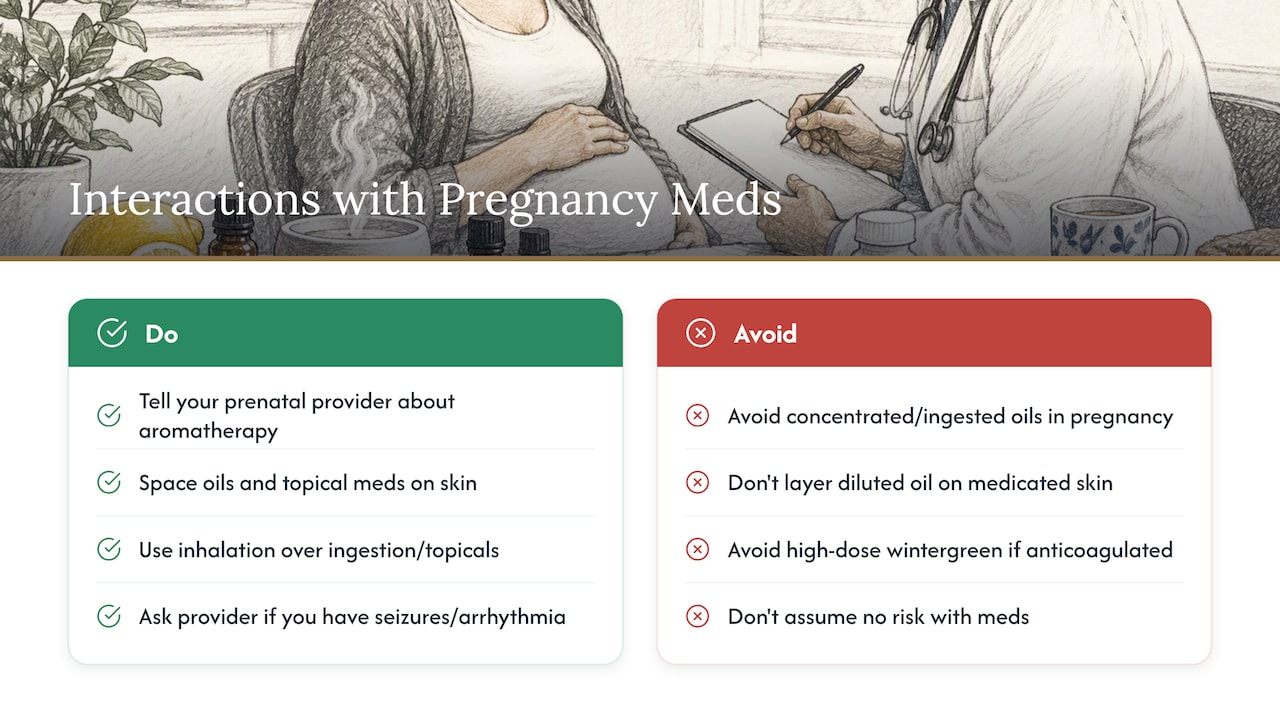
Essential oils aren’t inert just because they’re plant-derived, and that matters if you’re managing a pregnancy condition with medication. Prenatal vitamins and standard antinausea medications generally don’t have documented interactions with inhaled aromatherapy, but a few situations call for more care.
If you’re on blood thinners or have a bleeding-related condition, oils with mild anticoagulant properties, like high doses of wintergreen (which you should be avoiding anyway for its methyl salicylate content), compound the risk rather than offset it. If you manage gestational diabetes or hypertension with medication, there’s no strong evidence that common aromatherapy oils interfere with these drugs when used by inhalation, but concentrated topical or ingested use introduces unknowns that haven’t been well studied in pregnant populations.
The more practical interaction to watch for is with existing skin treatments. If you’re using a prescribed topical medication for a pregnancy-related skin condition, layering a diluted essential oil on the same area can change absorption or irritate skin further. Space them apart or ask your provider how to sequence the two.
The safest default, absent oil-specific research on your exact medication, is to mention any aromatherapy routine at your prenatal visits the same way you’d mention a supplement. Providers can flag conflicts you wouldn’t think to ask about, particularly if you’re managing a condition like a seizure disorder or arrhythmia alongside a medication regimen.
9. Non-aromatic uses and their safety, including bath use
Baths are the most common non-aromatic use people ask about, and the answer depends heavily on how the oil is prepared. Essential oils don’t dissolve in water, so dropping them directly into bathwater means they float on the surface in a concentrated layer that can irritate skin or sensitive tissue on contact. The safer approach is to mix a drop or two into a dispersant, like a tablespoon of carrier oil, unscented bath product, or even whole milk, before adding it to the water.
Keep bath use occasional rather than daily, and avoid it altogether if your membranes have ruptured or you’re in active labor without direct medical guidance, since that changes how exposed tissue interacts with any additive in the water. Our dilution guide for skin and rituals covers carrier ratios if you want a bath blend that’s actually diluted rather than just diffused on the surface.
Beyond baths, some people use diluted essential oils in massage oil blends, lotions, or compresses. Undiluted application, whether in a bath, a massage oil, or directly on skin, is where most documented irritation and toxicity reports originate, according to Mayo Clinic’s guidance on essential oils and pregnancy. Small amounts in commercial toiletries are generally considered low risk, but a concentrated bath additive is a different exposure level entirely.
10. How we think about safety when customers ask us about pregnancy
We carefully source our oils and take pregnancy questions seriously rather than treating them as a sales moment. When someone asks us about using an oil during pregnancy, we point them toward dilution ratios and inhalation-first methods rather than guessing. We offer personalized aromatherapy consultations to accommodate different trimesters, histories, or sensitivities, and we do not promise specific health outcomes from any oils.
— abdelmuhsen
Where to find vetted oils and book a consultation
We carry a focused range of essential oils and seed oils sourced directly from Palestinian growers, each one documented for origin and extraction method so you know exactly what you’re diluting into a carrier before you use it.

If you’re pregnant and curious about a specific oil, our free aromatherapy consultation is the fastest way to get a straight answer tailored to your situation rather than a generic product label. Browse our essential oils and seed oils to see what we carry, and reach out for a consultation before adding anything new to your routine.
This article is general information, not a substitute for advice from a qualified doctor. Consult a qualified healthcare professional about your own circumstances before acting on anything here.
FAQ
Which essential oils should be avoided during pregnancy?
Clary sage, pennyroyal, wintergreen, and camphor-rich oils top most clinical avoid-lists because of uterine-stimulating effects, documented liver toxicity, salicylate toxicity, and seizure risk. Large doses of rosemary, thyme, and oregano are also generally discouraged beyond trace culinary use.
Is it safe to smell peppermint oil while pregnant?
Brief inhalation of peppermint is generally considered low risk for most pregnant people, though randomized trials summarized by Evidence Based Birth found no significant nausea benefit over placebo. If you have a seizure disorder or G6PD deficiency, check with your provider first given menthol’s stimulating properties.
Why no hummus when pregnant?
This concern isn’t about hummus itself but about ingredients sometimes mixed into it, like raw tahini made from unpasteurized sesame paste or added raw garlic in large amounts, which some providers flag cautiously. Standard store-bought or home-cooked hummus made with cooked, pasteurized ingredients is widely considered fine during pregnancy.
Are essential oils safe to use during pregnancy at any dilution?
No single dilution is universally declared “safe,” but most clinical guidance supports roughly 1% to 1.5% for general pregnancy use, moving up to around 2% during labor or postpartum under supervision. Ingestion is discouraged at any dilution, and inhalation or small-area diluted topical use remains the preferred approach.
What should I do if I ingest an essential oil accidentally while pregnant?
Call Poison Control right away and follow their guidance, since the right next step depends on the specific oil and amount. Seek emergency care immediately if you notice breathing difficulty, seizure activity, or confusion.
Sources
Recommended
Frequently Asked Questions
Is it safe to smell peppermint oil while pregnant?
Brief inhalation of peppermint is generally considered low risk for most pregnant people, though randomized trials summarized by Evidence Based Birth found no significant nausea benefit over placebo. If you have a seizure disorder or G6PD deficiency, check with your provider first given menthol's stimulating properties.
Why no hummus when pregnant?
This concern isn't about hummus itself but about ingredients sometimes mixed into it, like raw tahini made from unpasteurized sesame paste or added raw garlic in large amounts, which some providers flag cautiously. Standard store-bought or home-cooked hummus made with cooked, pasteurized ingredients is widely considered fine during pregnancy.
Are essential oils safe to use during pregnancy at any dilution?
No single dilution is universally declared "safe," but most clinical guidance supports roughly 1% to 1.5% for general pregnancy use, moving up to around 2% during labor or postpartum under supervision. Ingestion is discouraged at any dilution, and inhalation or small-area diluted topical use remains the preferred approach.