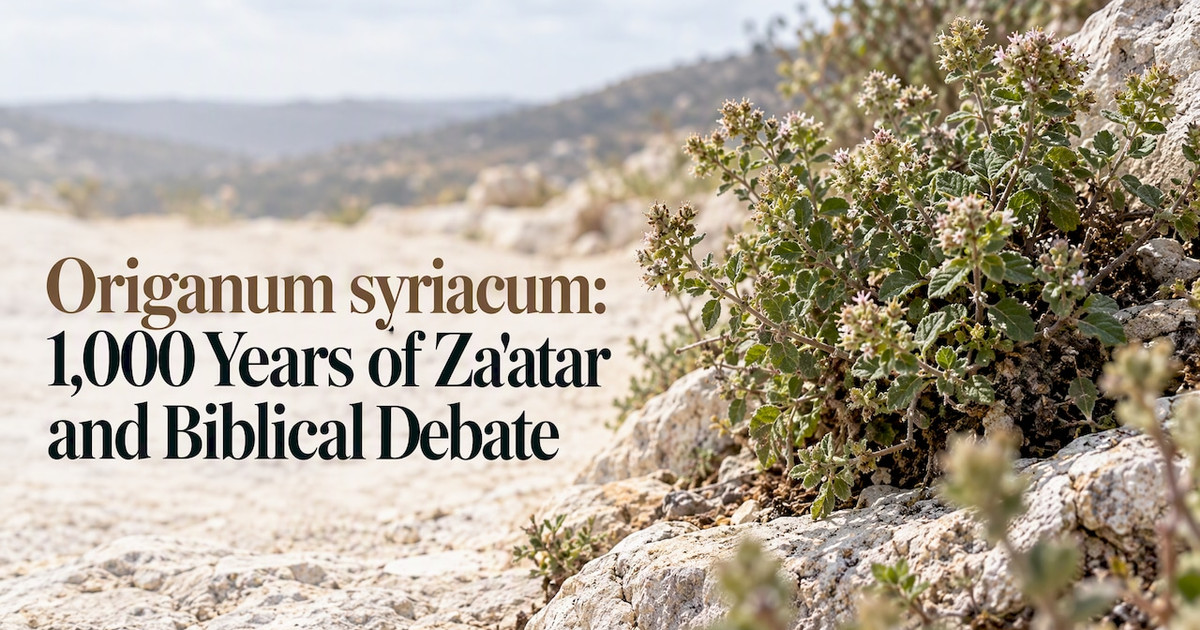

Modern scholarship most often identifies Origanum syriacum as the strongest candidate for the Bible’s hyssop, known in Hebrew as ezov, based on its native range across the Levant, its woody stems and clustered leaves suited to ritual sprinkling, and its unbroken culinary and ceremonial use in the region. The fuller picture, drawn from scripture, etymology, archaeobotany, and living tradition, is more layered than a single label, and it rewards a closer look.
Key Takeaways
Origanum syriacum is the most plausible biblical hyssop due to its native range, morphology, continuous local naming, and historical use in rituals and cuisine.
|
Point |
Details |
|
Historical use as culinary herb |
Origanum syriacum has been a key ingredient in za’atar for centuries, continuously linking it to regional culinary traditions. |
|
Cultural and ritual significance |
The plant’s symbolic role in purification rites reflects its longstanding sacred status in Jewish and regional practices. |
|
Ethnobotanical and archaeobotanical evidence |
Living practices and archaeological finds support the plant’s historical presence, although physical evidence is limited. |
|
Scholarly debate and botanical identification |
The case for Origanum syriacum relies on geographic, morphological, and naming continuity rather than definitive proof. |
|
Palinova’s approach |
We source our Origanum syriacum from Palestinian hillsides, ensuring traditional harvesting and authentic cultural heritage. |
Table of Contents
Historical Culinary and Folk Uses
Long before anyone debated its place in scripture, Origanum syriacum was already a kitchen staple across the Levant, and it remains one today as the defining ingredient in za’atar. Traditional za’atar blends combine dried, crumbled Origanum syriacum leaves with sumac, toasted sesame seeds, and salt, though regional recipes vary the ratios and sometimes add thyme or marjoram. Cooks and herbalists in the region have long preferred Origanum syriacum over related labiates for its sharper, more pungent aroma and its ability to hold flavor after drying.
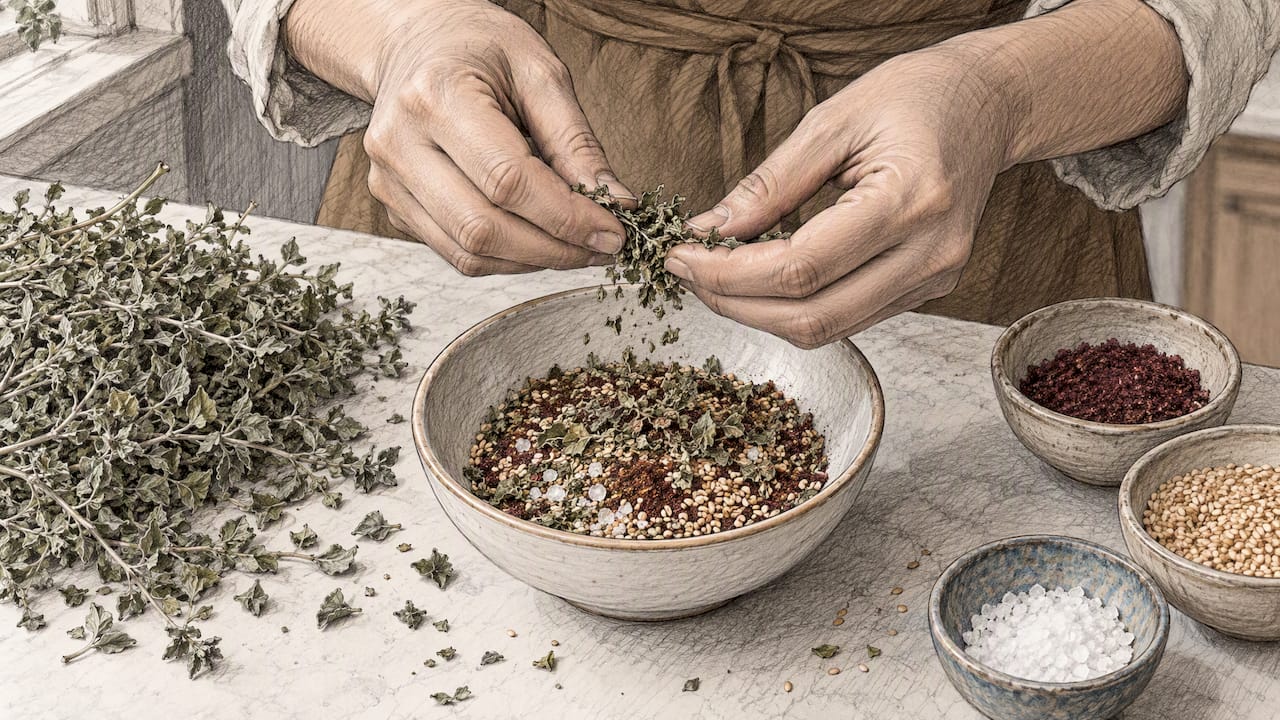
The culinary record stretches back centuries. The tenth-century Baghdadi cookbook Kitab al-Tabikh records za’atar as a standard garnish and a frequent seasoning across many dishes, evidence that the blend was already a fixture of regional cooking a thousand years ago. That continuity, from a medieval kitchen manuscript to a modern breakfast table, is one of the more striking threads tying ancient and contemporary use together.
A 2021 botanical review of Origanum syriacum describes the plant’s rise in market interest alongside its long-standing role in traditional blends, noting its established place in Levantine cuisine and its growing recognition in wellness and food science circles.
Beyond the kitchen, Origanum syriacum carried a folk-medicine reputation that predates modern pharmacology by well over a thousand years:
-
Classical writers, including Dioscorides and sources associated with the Hippocratic tradition, recorded oregano-type plants being used for respiratory complaints, coughs, and chest congestion.
-
Communities across the region burned sprigs of the plant as a household fumigant, believing the smoke cleared stale air and warded off illness.
-
Dried leaves were steeped as a tea for digestive discomfort, a practice that persists in home remedies across the eastern Mediterranean today.
These overlapping roles, as food, medicine, and fumigant, help explain why a plant with such ordinary kitchen status could also carry the weight of sacred ritual. A plant that people already trusted for cleansing smoke and healing teas was a natural candidate for purification rites that called for sprinkling, burning, or symbolic cleansing.
Scholarly Debate and Etymology
Not every scholar agrees on a single identification for ezov, and the debate is worth laying out plainly. The case for Origanum syriacum rests on three pillars: it grows natively and abundantly across the exact geography where the biblical events are set, its woody, clustered form matches the ritual descriptions of dipping and sprinkling, and the Hebrew and Arabic names for the plant, ezov and za’atar, have remained linked to it continuously in local speech for centuries rather than being revived or reconstructed later.
Competing proposals have been floated over the years, each with a weaker case:
-
Thymus species, close botanical cousins, share some morphological features but lack the same depth of continuous local naming tradition.
-
Capparis (caper plants) have been suggested based on their presence in rocky walls, matching a biblical reference to hyssop growing “out of the wall,” but their structure does not suit a sprinkling ritual.
-
Sorghum reeds have been proposed specifically for the Gospel crucifixion scene, since a reed could physically reach a sponge up to a crucified figure, something true hyssop struggles to do.
-
Hyssopus officinalis, the plant that gave hyssop its English name, is not native to the Levant at all, and its association with ezov traces back to translation choices rather than botanical evidence.
The word Origanum itself comes from Greek roots meaning “mountain” and “brightness,” a name that reflects where the plant grows and how it was regarded in antiquity. The Hebrew ezov, meanwhile, has no clear etymological relative outside the Semitic language family, which has made philologists rely on context and later rabbinic commentary rather than word origins alone. Classical rabbinic sources, including discussions attributed to Maimonides, describe the plant used in ritual law as a local marjoram-like herb rather than the European hyssop, a reading that lines up with the modern botanical case for Origanum syriacum. Mishnaic and Talmudic rulings on which “hyssop” qualified for ritual use often specified “the hyssop as commonly known,” a phrase that only makes sense if the ritual plant was something everyday and locally recognized, which points squarely at a plant like za’atar rather than an imported or rare species.
Archaeobotanical and Ethnobotanical Evidence
Physical evidence for Origanum syriacum’s ancient use is real but uneven. Archaeobotanical surveys of the region have recovered scattered seed and pollen remains associated with Origanum-type plants, with some finds attributed to Bronze Age and later contexts, though researchers are careful to note that this physical record is thin compared to the documentary one. Preservation bias plays a role here: certain seed types survive better in the archaeological record than others, and excavation has historically concentrated on urban centers rather than the rural hillsides where wild Origanum syriacum actually grows. An absence of seeds at a given site does not mean the plant was absent from daily life.
Living tradition fills much of that gap. The 2019 ethnobotanical survey published in the Journal of Ethnobiology and Ethnomedicine documents Origanum syriacum in active use among Samaritan and Palestinian rural communities, in practices that echo the biblical descriptions closely enough to suggest genuine continuity rather than coincidence. That survey is part of a broader pattern in ethnobotanical fieldwork across the eastern Mediterranean, where researchers consistently find the same plant named, gathered, and used in ways that track the ancient textual record.
A few points are worth holding onto when weighing this evidence:
-
Archaeobotanical remains confirm that Origanum-type plants existed in the region during the relevant periods, even if the sample size is small.
-
Ethnobotanical fieldwork provides a living bridge between ancient texts and present-day practice, showing the same name and the same uses persisting over time.
-
Oral history and continuous naming carry real evidential weight in a region where written records are incomplete, and scholars increasingly treat them as a legitimate complement to physical remains rather than a weaker substitute.
Taken together, the physical and ethnographic evidence does not amount to proof in the strict sense, but it converges on Origanum syriacum more consistently than on any competing plant.
Symbolism and Ritual Practice
Beyond its practical role, hyssop carried symbolic weight in biblical literature that outlasted its physical use. Rabbinic exegesis repeatedly frames hyssop as a symbol of humility, often set in direct contrast with cedar, the tall and stately tree used alongside it in the leper-cleansing rite of Leviticus 14. The pairing of a lowly, ground-hugging herb with a towering tree reads as a deliberate statement: purification draws on both the humble and the grand, and the small plant is not beneath the task.
That symbolism shaped how the plant was applied in ritual:
-
In the Passover account, hyssop sprinkled blood on doorposts, a protective and covenantal act performed with a modest household herb rather than an elaborate instrument.
-
In the Red Heifer rite, hyssop helped apply the water of purification, again placing a common plant at the center of a solemn ceremony.
-
Across the region, fumigation with burning herb bundles, including Origanum syriacum, served both practical and symbolic cleansing roles, a practice echoed in funerary customs where smoke was thought to purify the space around the dead.
Pro Tip: When reading hyssop references in scripture, notice whether the passage treats the plant as a physical tool (sprinkling, dipping) or a metaphor (Psalm 51’s “purge me with hyssop”); the two uses reinforce each other but serve different purposes in the text.
Greco-Roman tradition offers a loose parallel: aromatic herbs played a role in household and temple purification rites across the ancient Mediterranean, and the broader practice of using fragrant plants to mark a boundary between the unclean and the sanctified was shared, in different forms, across cultures that otherwise had little religious overlap.
Za’atar Today: Identity, Commercialization, and Conservation
Za’atar has grown into something larger than a spice blend in modern Palestinian life. It appears in poetry, in family recipes passed down as markers of identity, and in everyday meals that connect households to land and heritage. Essays on the political ecology of za’atar describe how the plant has become a point of cultural pride precisely because its wild harvesting ties communities directly to specific hillsides and seasons, a relationship that store-bought substitutes cannot replicate.
That same attention has brought friction. Growing international demand for za’atar has pushed commercialization and, in some cases, cultivation of Origanum syriacum on farms rather than wild harvesting, a shift that changes both the plant’s flavor profile and its cultural meaning for communities who have always gathered it by hand. Legal and regulatory debates over wild harvesting have added another layer of tension, with some restrictions framed as conservation measures and others viewed by local harvesters as a threat to a practice that predates the rules themselves.
Recent genetic research adds useful context here. Phylogeographic studies of Origanum syriacum indicate it is an ancient species native to the eastern Mediterranean, a finding consistent with the long historical record of wild stands persisting in the same hills for thousands of years rather than arriving through later cultivation or trade.
A few threads run through this modern chapter:
-
Za’atar functions as a cultural touchstone in Palestinian identity, appearing in literature and daily ritual alike, not only as food.
-
Commercialization has increased market interest in Origanum syriacum, bringing both economic opportunity and pressure on wild populations.
-
Conservation and legal debates around wild harvesting directly affect the communities whose traditions depend on continued access to the plant in its natural habitat.
Comparative Look at Origanum Syriacum Across Near Eastern Cultures
Origanum syriacum’s story is not confined to the Hebrew Bible. Aromatic Lamiaceae plants held ceremonial roles across the ancient Near East more broadly, used in Mesopotamian and Egyptian ritual contexts for fumigation, embalming preparations, and temple offerings, though the specific species named in those traditions are not always precisely identifiable. Greek and Roman writers treated oregano-type herbs as both medicine and a marker of hospitality and household well-being, a milder echo of the purification role it carried in Hebrew ritual texts.
What stands out is how consistently plants from this same botanical family show up wherever purification, healing, or domestic protection rites appear in the region’s ancient literature, even when the exact species shifts from one tradition to another. Origanum syriacum’s specific claim to the biblical ezov is strongest because of the tight match between its native range, its continuous local naming, and the precise ritual descriptions in the Hebrew text, a convergence that few other regional traditions offer with the same clarity. That specificity is part of why biblical scholarship has settled on it more confidently than comparable identifications in neighboring Near Eastern source material, where the botanical record is often vaguer about which exact plant a given ritual required.
What the Evidence Leaves Us With
The strongest case for Origanum syriacum as biblical hyssop rests on the convergence of geography, morphology, and unbroken naming tradition rather than any single decisive proof. Genuine uncertainty remains, particularly around the Gospel crucifixion scene, where a hyssop branch seems physically mismatched to the task described. Readers exploring this topic, whether for scholarship, cooking, or ritual interest, do well to treat za’atar and its history with the same care its harvesters bring to the hillsides it grows on, and to look to both primary texts and current ethnobotanical research rather than settling for a single tidy answer.
— abdelmuhsen
Bring Origanum Syriacum Into Your Own Routine
We source our Origanum syriacum directly from Palestinian hillsides, working with growers who harvest the plant traditionally, ensuring that what reaches you reflects the heritage tied to its culinary and ritual use. Our Origanum syriacum essential oil is pressed without synthetic additives, and our za’atar blend follows traditional proportions rather than a mass-market shortcut.
If you are new to working with this oil, we offer aromatherapy consultations to help you figure out the right use for your skin, kitchen, or home practice before you commit to anything. Browse the full range of Palestinian botanical products we offer, from seed oils to skincare, and reach out for a consultation whenever you want guidance tailored to what you’re trying to achieve.
FAQ
What is Origanum syriacum?
Origanum syriacum is a woody shrub in the mint family, native to the eastern Mediterranean, commonly known as Syrian oregano or za’atar. It is widely regarded by modern scholars as the most likely candidate for the biblical hyssop mentioned in Hebrew Bible purification rituals, based on both ethnobotanical research and its native growing range.
What is the symbolic meaning of the oregano plant?
In biblical literature, hyssop, widely identified with Origanum syriacum, symbolizes humility and purification, often contrasted with the stately cedar tree in purification rites. That symbolism carried into practices like the Passover doorpost ritual and the Red Heifer ceremony, where a modest herb performed a sacred cleansing function.
Which country is oregano most famous for?
Origanum syriacum in particular is most closely associated with the Levant, especially Palestine, where it forms the core ingredient of za’atar and carries deep cultural and historical significance. Political ecology research on za’atar documents how closely the plant is tied to Palestinian land and identity specifically.
What does oregano mean in Greek?
The name Origanum comes from Greek roots meaning “mountain” and “brightness,” reflecting the plant’s hillside habitat and its ancient reputation as a source of well-being. The name itself predates the specific species identification debates that later connected it to biblical hyssop.
Does Palinova offer products made from Origanum syriacum?
Yes, we offer an Origanum syriacum essential oil and a traditional za’atar blend, both sourced from Palestinian growers. We also provide free aromatherapy consultations to help you choose the right product for your needs.
Sources
Origanum syriacum goes by several names depending on who is talking about it: Syrian oregano in botanical literature, za’atar in Arabic and Hebrew colloquial speech, and “Bible hyssop” in the context of scripture. The plant belongs to the mint family, Lamiaceae, and grows as a low, woody shrub across rocky hillsides from the eastern Mediterranean coast into the Jordan valley. A 2019 ethnobotanical survey lists Origanum syriacum among the small number of species that can be tied directly to medicinal and ritual references in the Hebrew Bible, and it notes that the same plant continues to appear in ritual use among communities in the region today.
What makes the botanical case persuasive is the plant’s physical structure. Its stems are fibrous but pliable, its leaves grow in dense, hairy clusters, and a cut sprig holds liquid well without falling apart when dipped and shaken. That matters because several biblical passages describe hyssop being dipped in liquid and used to sprinkle it on a surface, a person, or an object, a task that a soft-leaved or brittle plant could not perform.
The scriptural record mentions hyssop at several key points:
-
A political ecology of za’atar
Translation history complicates the picture further. Ancient translators working on the Septuagint and later the Vulgate rendered the Hebrew ezov using Greek and Latin words that, over time, became associated with Hyssopus officinalis, a plant native to parts of Europe and not to the Levant. That translation choice shaped centuries of Western art, liturgy, and biblical commentary, even though the European hyssop does not grow wild in the region where these events are set. Readers who want a deeper look at how ezov became linked to specific Arabic and Hebrew names can see our notes on Origanum syriacum’s common names and biblical roots.
Recommended
Frequently Asked Questions
What is Origanum syriacum?
Origanum syriacum is a woody shrub in the mint family, native to the eastern Mediterranean, commonly known as Syrian oregano or za'atar. It is widely regarded by modern scholars as the most likely candidate for the biblical hyssop mentioned in Hebrew Bible purification rituals, based on both ethnobotanical research and its native growing range.
Which country is oregano most famous for?
Origanum syriacum in particular is most closely associated with the Levant, especially Palestine, where it forms the core ingredient of za'atar and carries deep cultural and historical significance. Political ecology research on za'atar documents how closely the plant is tied to Palestinian land and identity specifically.
What does oregano mean in Greek?
The name Origanum comes from Greek roots meaning "mountain" and "brightness," reflecting the plant's hillside habitat and its ancient reputation as a source of well-being. The name itself predates the specific species identification debates that later connected it to biblical hyssop.
Does Palinova offer products made from Origanum syriacum?
Yes, we offer an Origanum syriacum essential oil and a traditional za'atar blend, both sourced from Palestinian growers. We also provide free aromatherapy consultations to help you choose the right product for your needs.